Ads Accessibility
What load-time accessibility checks miss on ad-supported news sites — auditing pages after scripted use, with and without ads, and inside third-party ad frames.
What Load-Time Accessibility Checks Miss on Ad-Supported News Sites
Automated accessibility checkers usually audit a page once, at load, and only its top-level document. On ad-supported pages, ads keep loading as you scroll and render in cross-origin frames those checks do not reach. We audit 2,298 news sites before and after a minute of use, with and without ads, and inside cross-origin frames.
1University of California, Davis
Numbers
At a Glance
Abstract
Overview
Why ads matter for accessibility. Visually impaired users browse the web with screen readers. That only works if web pages, including the third-party ads they carry, are accessible. The Web Content Accessibility Guidelines (WCAG) define what an accessible page must do, and laws such as Section 508 in the United States and the European Accessibility Act build on them. Ads are a known source of failures, and they are hard for publishers to fix, because third-party vendors write and serve them.
What load-time checks do. Developers usually check accessibility with automated tools such as axe-core. Most audits run once, on the loaded page, before any interaction, and only in the publisher’s top-level document.
What they miss. Ad-supported pages keep changing after load: ad slots fill as you scroll, creatives refresh, and overlays appear. Ads also render inside cross-origin frames, which a checker injected into the publisher’s document cannot read. A load-time audit in the top-level document sees neither.
This paper measures what these blind spots hide, and who is responsible for it. We ask three questions:
- Missed failures. What does an audit after a minute of use find that the load-time audit does not?
- Attribution. Which of these new failures do ads cause, and does matching failing markup against ad patterns find them correctly?
- Inside frames. What violations sit inside cross-origin frames, and who serves those frames?
A note on terms. A violation is any axe-core rule failure, and a page fails if it has at least one. “Fail” here means an accessibility violation, not a crash. axe-core’s default rules include some best-practice rules beyond WCAG, so we report WCAG-only results separately.
Method
Study Design and Harness
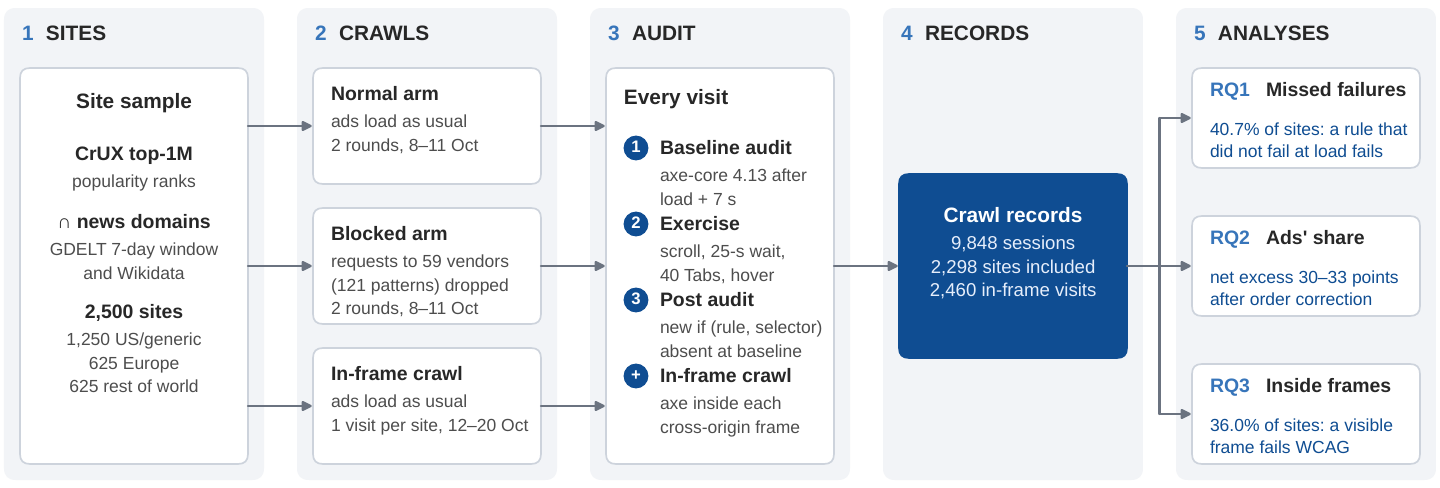
The harness is built on Playwright and drives headless Chromium from a US vantage point. It combines three techniques. Each has precedents; combined, they separate what a load-time audit misses from what the ads cause.
Audit, exercise, audit
Seven seconds after load, axe-core 4.13 runs with its default rules. The harness then scrolls in 540-pixel steps, waits 25 seconds, presses Tab 40 times and hovers over up to 15 ad-like elements. The exercise takes about a minute, and a second audit follows. A violation is new if its (rule, selector) pair was absent at load.
With and without ads
Every site is visited in two arms. In the normal arm, ads load as usual. In the blocked arm, the browser drops every request to one of 59 vendors on a hand-curated list, mostly ad, analytics and tracking vendors plus six non-ad services such as a paywall and a video player. Each site is its own counterfactual: the per-site difference in new violations (∆) estimates the ads' share.
Inside cross-origin frames
A separate crawl runs axe-core with WCAG A and AA rules inside each cross-origin frame, nested frames included, and records who serves it. A frame counts only if it is visible: its body covers more than 2,500 px².
Sites. We sample 2,500 sites from the Chrome UX Report top-1M list, restricted to domains that appear as news sources in GDELT or Wikidata, with regional quotas: 1,250 US or generic, 625 European and 625 from the rest of the world. We drop 35 platform and government domains, which leaves 2,465. Not every site in a news corpus is a news publisher: in a hand-labeled random sample of 50, 41 (82.0%) were. “News sites” is shorthand for sites from news corpora.
Crawls. Each arm was crawled in rounds between 8 and 11 October 2026, alternating between the arms; we analyze two rounds per arm. A visit is included if it met no bot or consent wall, returned an HTTP status below 400, completed both audits and pressed Tab at least ten times. That leaves 2,298 sites for RQ1, 2,254 paired sites for RQ2 and 2,273 sites in the in-frame crawl for RQ3.
Attribution by markup. Blocking needs a second visit to every site. A cheaper method looks at the failing element and checks whether its markup looks like an ad, for example a selector such as div-gpt-ad. RQ2 compares this selector matching against blocking.
Results
Findings by Research Question
| Research question | Sites | Finding |
|---|---|---|
| RQ1 Missed failures | 2,298 | On 40.7% of sites, a rule that did not fail at load fails after a minute of use (37.6% for WCAG rules). On half of these, the newly failing rules fail only inside frames. Only 24.4% of sites see this on every visit. |
| RQ2 Attribution | 2,254 | Ads add new violations on 30–33 percentage points more sites than they reduce them, after correcting for visit order. Selector matching agrees with blocking on naming rules but misattributes structure failures. |
| RQ3 Inside frames | 2,273 | On 36.0% of sites, a visible cross-origin frame fails a WCAG rule, mostly through missing names. On 60% of these sites, a listed vendor serves the frame. |
RQ1: What does the load-time audit miss?
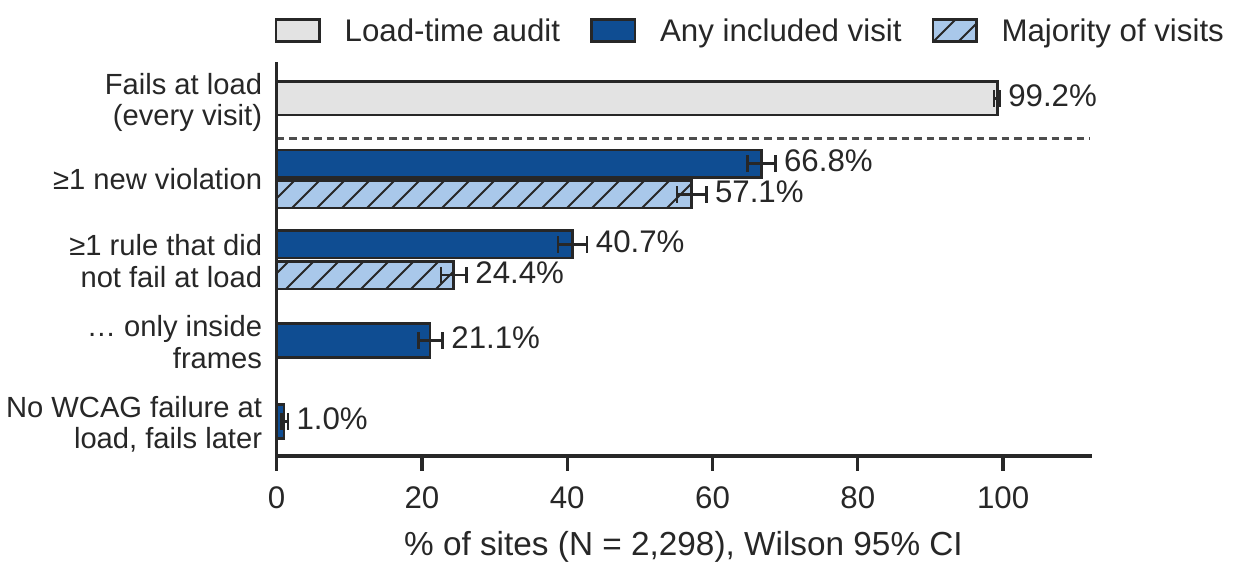
A load-time audit rarely gets wrong whether a page fails. On 99.2% of sites, every included visit already fails at load, with a median of 61 failing nodes per visit. Only 24 sites (1.0%) have no WCAG failure at load and fail a WCAG rule after the exercise.
What it gets wrong is which failures a page has. After the exercise, 66.8% of sites have at least one new violation, or 59.8% if we ignore elements that look re-rendered. Many of these only repeat a rule that already failed at load, so we also count newly failing rules: rules that fail after the exercise but failed nowhere on the page at load. That happens on 40.7% of sites (95% CI 38.7–42.8). Most are WCAG rules about names, failing inside frames: frame-title on 12.7% of sites, aria-command-name on 12.2% and image-alt on 10.3% (Figure 4 in the paper).
These failures do not always come back. Only 24.4% of sites have a newly failing rule on every visit. The exercise also mixes about a minute of waiting with the gestures, so we cannot tell which of the two caused them.
RQ2: Which new failures do the ads cause?
Of the 2,254 paired sites, ∆ > 0 on 50.5% and ∆ < 0 on only 9.2%; the rest show no difference. A typical site gains 3.5 more new violating nodes with ads (Hodges–Lehmann estimate, 95% CI 3.0–4.0). Four alternative ways of counting give ∆ > 0 on 44–50% of sites and ∆ < 0 on 7–16%.
Pages also change between visits by chance. Two identical normal visits give different counts on 52.8% of sites, but the earlier visit is higher only 7.1 points more often than the later one. After correcting for that order bias, ads add new violations on 30–33 percentage points more sites than they reduce them. Two further checks point to the ads rather than to how we visited:
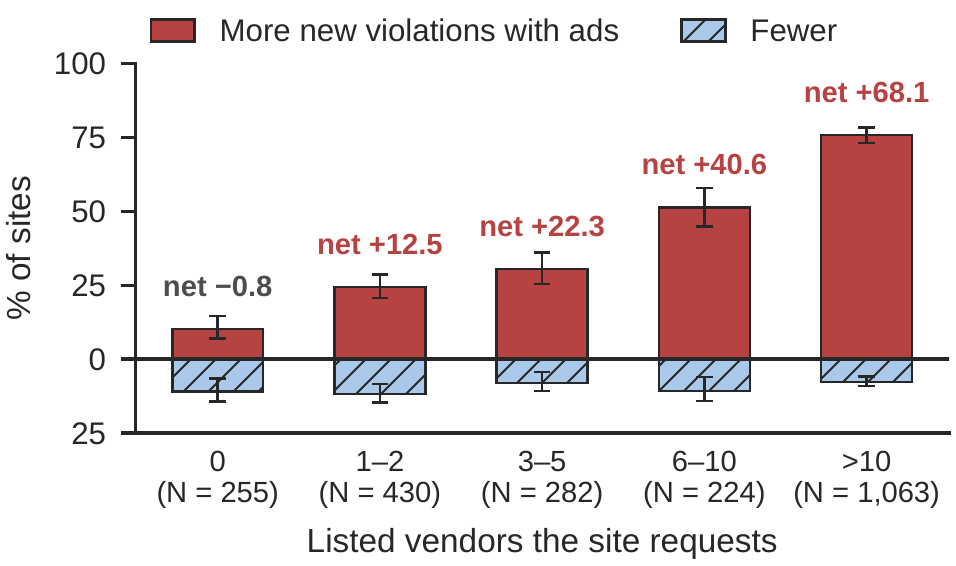
- Placebo. On the 255 sites that request no listed vendor, blocking removes nothing, and ∆ is positive and negative about equally often (10.2% and 11.0%).
- Dose. The gap grows with the number of listed vendors a site loads, from 12.5 points with one or two vendors to 68.1 points with more than ten.
Does selector matching agree with blocking? The table below (Table I in the paper) shows the share of new violations each method assigns to ads. Naming rules require an accessible name, such as alternative text; structure rules concern page structure and presentation.
| Rule family | Selector: ad tokens | Selector: + sponsored | Blocking: normal first | Blocking: blocked first |
|---|---|---|---|---|
| Naming (17 rules) | 59.5% | 60.1% | 67.1% | 59.7% |
| Structure (23 rules) | 11.0% | 37.6% | 40.1% | 34.3% |
On naming rules the methods roughly agree, because the failing element is usually the ad itself and its markup names the ad network. On structure rules they do not. Adding the sponsored-content pattern brings selector matching to 37.6%, which looks like agreement but is not. Nearly all of the ads’ effect on structure rules (91.7%) comes from 5% of sites, two thirds of which carry native-ad widgets. There, blocking assigns about 70% of new structure violations to ads and the ad-token pattern only 11.7%. On the other 95%, blocking finds almost no ad effect, yet the ad-token pattern still assigns 10.3% to ads. Selector matching agrees with blocking only in aggregate.
RQ3: What fails in frames, and who serves them?
In the main audit, 13.7% of violating nodes after the exercise lie inside frames, two thirds of them in frames that look like ads. A checker that runs only in the top-level document misses all of them. In the in-frame crawl, at least one visible cross-origin frame fails a WCAG rule on 818 of 2,273 sites (36.0%, 95% CI 34.0–38.0). That frame comes from a listed vendor on 21.6% of sites and from another host on 20.9%, such as a video embed, a social plugin, a consent dialog, or an ad host our list misses. Not all failing frames are ads.
Most in-frame failures are missing names. The most common rules are link-name and image-alt: links and images with no accessible name, which a screen reader cannot describe.
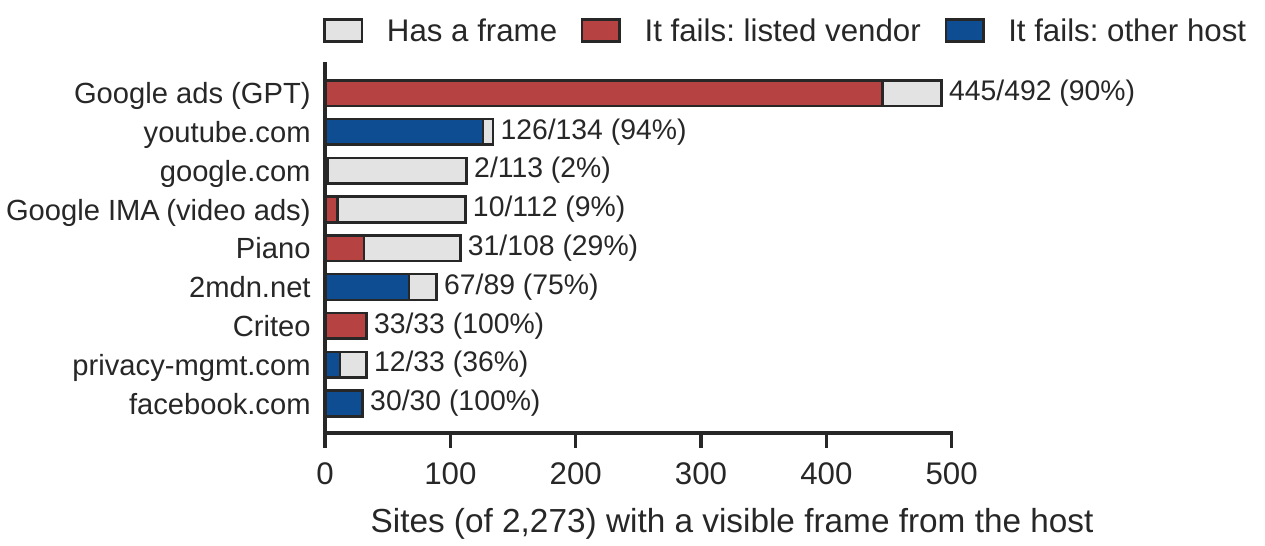
Google’s ad frames hold 43.5% of in-frame violating nodes, but 84.3% of sites request Google’s ad and tag hosts, so that share reflects how widely Google is used as much as how its frames are built. Failure rates per host differ widely: Google’s ad frames fail on 90% of the 492 sites that show them and YouTube embeds on 94%, while Piano’s frames fail on 29% and Google’s video-ad frames (IMA) on 9%. Whether a frame fails depends on who serves it.
Implications
Takeaways
Audit after interaction, and more than once
Audit again after a scripted interaction, with third-party code loaded, and report the rules that newly fail. Repeat the run: these failures do not always recur, much like flaky tests. A test environment that stubs or blocks ads sees only what our blocked arm sees.
Attribute failures with blocked runs, not markup
Markup patterns are an unreliable way to decide who caused a failure. Re-running the test with one component removed needs no knowledge of its markup. Because pages vary between visits, it needs several runs in both orders.
Look inside frames
The publisher cannot edit a cross-origin frame, so the vendor must fix it. Most in-frame failures are missing names, which a vendor can often fix once, in a shared template. Publishers can still choose vendors and embeds, and failure rates differ widely between them.
Conformance claims leave a gap
WCAG allows partial conformance when failures come only from content "from uncontrolled sources". On ad-supported pages this is not a corner case: on 21.6% of sites, a visible vendor frame fails a WCAG rule. The publisher's claim may exclude these failures, and the vendors that serve them make none.
Limitations. Automated checkers cover only part of WCAG, and the harness models gestures but not a screen reader. Blocking is imperfect: the list misses unlisted and first-party ad code, removes some non-ad services, and leaks. The arms were not counterbalanced and ran at different times of day, so the size of the effect is specific to our crawl schedule, although its direction held in every check. We crawl homepages only, from a US vantage point, in Chromium, and about one in five sampled sites is not a news publisher.
Artifact. The harness, the records of both crawls and all analysis scripts are public on GitHub. One script, scripts/replicate.sh, regenerates the numbers and figures in the paper from the frozen crawl data in about four minutes and checks each result against the reported value. The code is released under the MIT license and the data under CC BY 4.0.
Cite
BibTeX
@misc{hassnain2026adsaccessibility,
  author = {Hassnain, Muhammad},
  title  = {What Load-Time Accessibility Checks Miss on Ad-Supported News Sites},
  year   = {2026},
  note   = {Preprint},
}